
Chemical biology, medicinal chemistry and drug discovery
We continue to develop a range of chemistry-led approaches to interrogate novel targets/techniques for the treatment of disease. Our studies span efforts in curiosity-led basic science through to translational drug discovery. We also have a strong interest in the use of photochemically-active reagents in chemical biology, particularly in the context of photopharmacology.
Medicinal chemistry
We use enabling medicinal chemistry to validate and progress a range of new targets and approaches in drug discovery.
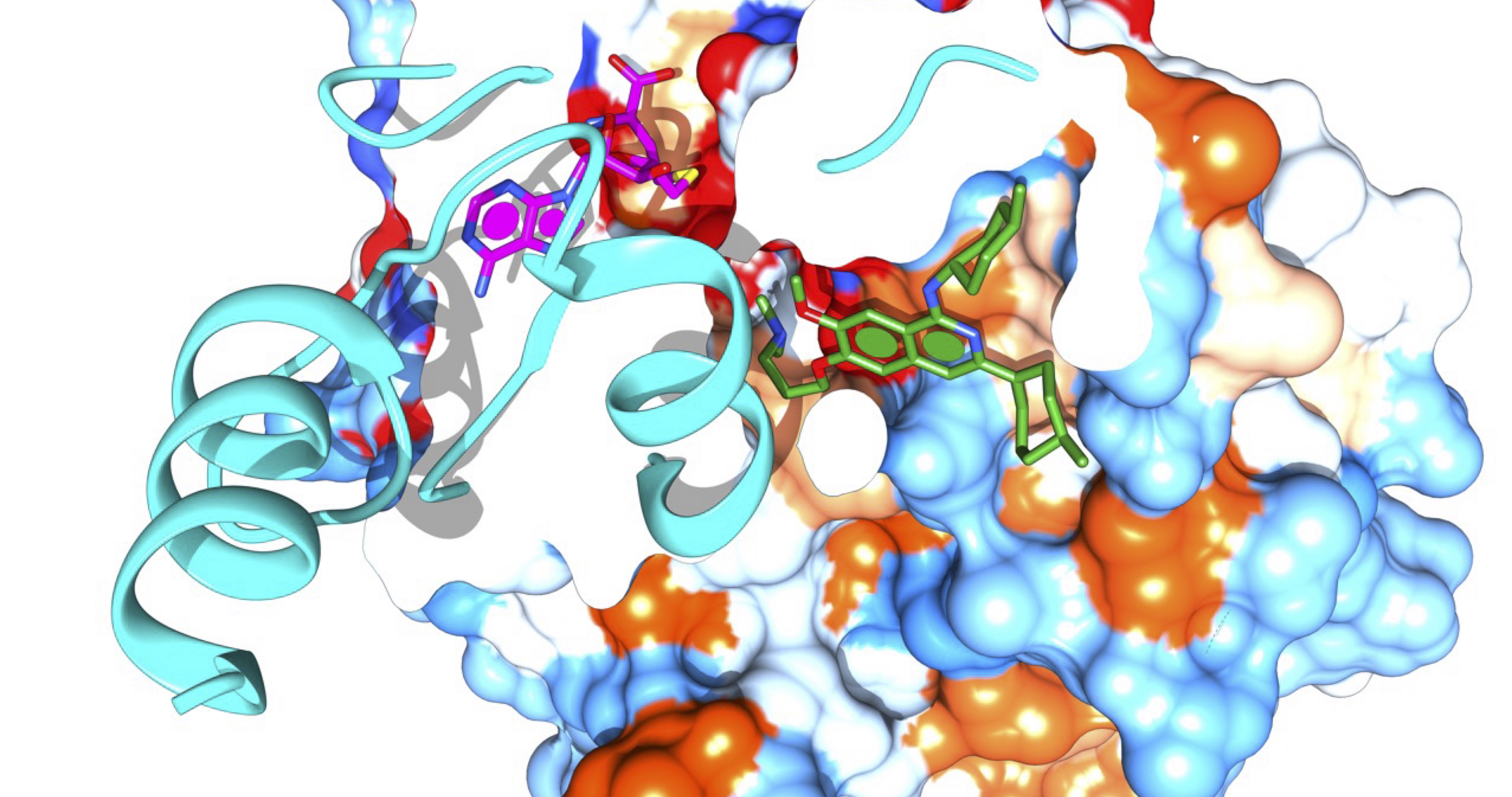
Some representative highlights include:
REV-ERB.
The nuclear receptor REV-ERB is a transcriptional regulator involved in the regulation of many physiological processes, fr
om circadian rhythm, to immune function and metabolism. Accordingly, REV-ERB has been considered a promising, but difficult drug target for the treatment of numerous diseases. In collaboration with Professor Hugh JM Brady, we have been exploring the potential for REV-ERB inhibition in a cell expansion process for the production of natural killer (NK) cells. NK cells are critical immune effector cells and the adoptive transfer of large numbers of cytolytic NK cells represents a rapidly developing cancer immunotherapeutic approach. Our proprietary data has demonstrated a promising and exciting approach to the generation of very large numbers of highly active NK cells for use as an adoptive cell therapy. This research led to the formation of NK:IO Ltd. Representative publications: WO2024047368, WO2024110758, Bioorg. Med. Chem. Lett. 2020, 30, 127395. DOI.
2. GCN2.
GCN2 is one of the four kinases that activates the Integrated Stress Response (ISR) to maintain cellular proteostasis, has been shown to support cancer cell growth and survival in multiple preclinical cancer models. As such, it represents an exciting new cancer target. In partnership with Professor Holger Auner and Apollo Therapeutics, we developed APL-4098, a highly potent and selective GCN2 inhibitor that has now entered clinical development. Representative publications: Clin. Cancer. Res. 2026, in press, WO2021250399.
3. Cyclin-dependent kinase 7 (CDK7).
CDK7 is an enzyme which phosphorylates RNA polymerase II (Pol II) at active gene promoters in order to permit transcription. Frequent misregulation of transcription via aberrant CDK7 levels or signaling has suggested CDK7 as a cancer target. We were previously involved in a large drug discovery team effort at Imperial College that took this project from a clinical hypothesis and virtual chemical scaffolds toa clinical drug candidate ICEC0942. This molecule, now called Samuraciclib, was licenced to Carrick Therapeutics and has completed Phase II clinical trials with FDA fast track status for breast cancer. Representative publications: Mol. Cancer Ther. 2018, 17, 1156. DOI; ChemMedChem 2017, 12, 372. DOI; Cancer Res. 2009, 69, 6208. DOI.
Photopharmacology
Photopharmacology is a rapidly growing approach that uses light to change the shape and/or properties of a therapeutic agent. Such photoswitching, in turn, changes the biological activity of the compound. Therefore, in its most simple form, photopharmacology is an approach to switch the activity of a drug ‘on’ and ‘off’ using light. Coupling our work on novel photoswitchable molecules to our interests in medicinal chemistry and chemical biology, we have a large number of ongoing collaborative projects aimed at the generation of photopharmacological agents. To date, we have published examples of heteroaromatic photoswitchable aminohydrolyse inhibitors as a photopharmacological antimicrobial approach, the ability to control targeted protein degradation with light using heteroaromatic azo PROTACs and the ability to control electrically excitable cells using a photoswitchable TRPA1 ligand that we called TRPswitch.
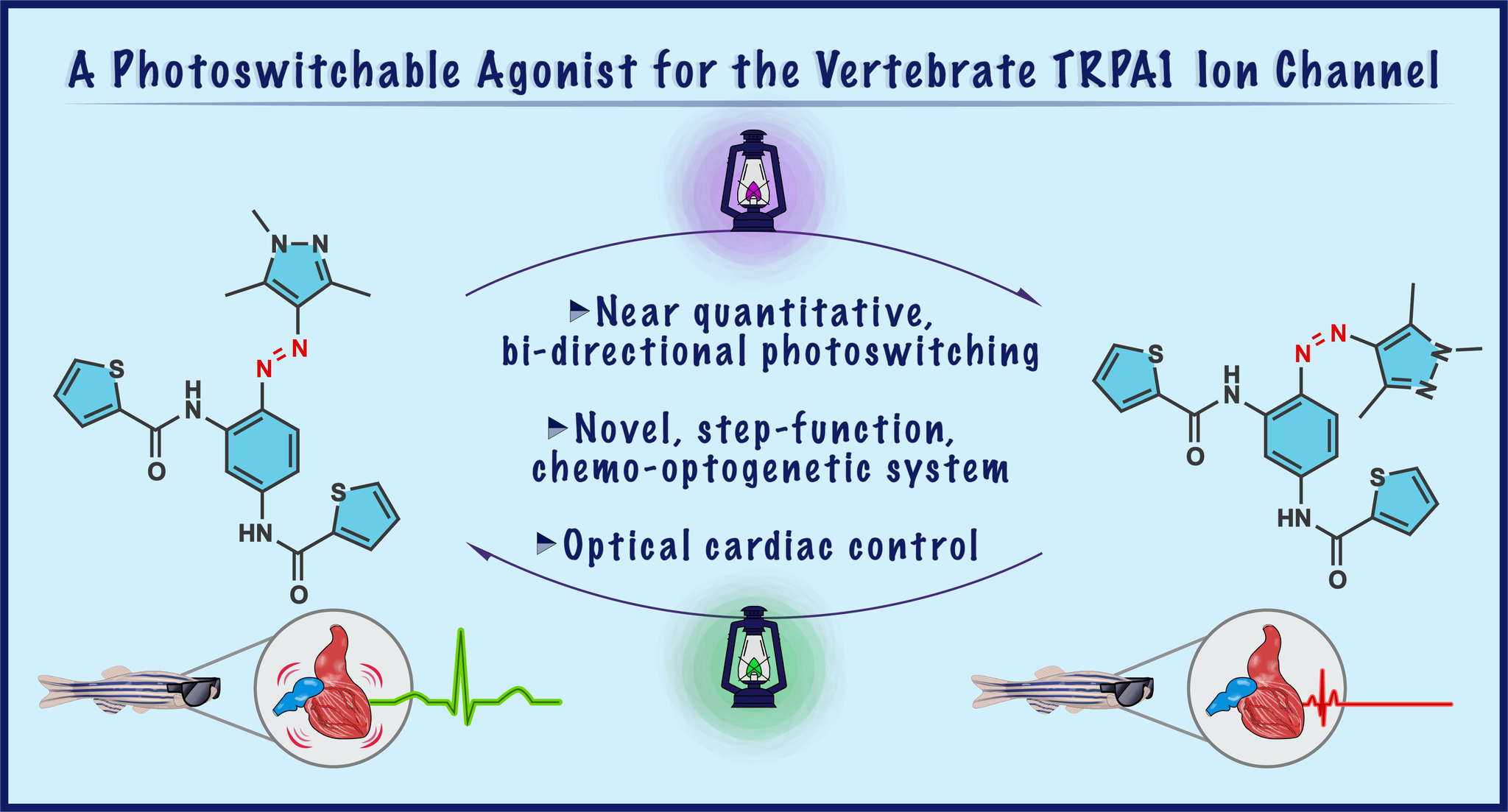
This latter study was particularly exciting as it allowed us to demonstrate photocontrol of physiology in live zebrafish larvae, using our heteroaromatic switches. The TRPA1/TRPswitch combination has a number of key advantages over other chemo-optogenetic approaches and should be particularly applicable in systems where a large depolarization current is needed or sustained channel activation is desirable. Representative publications: Chem. Sci. 2025, 16, 19777. DOI; Chem. Commun. 2022, 58, 10933. DOI; J. Am. Chem. Soc. 2020, 142, 17457. DOI; J. Med. Chem. 2020, 63, 11436. DOI.