Chiral Functional Materials and Devices
Chirality is a fundamental symmetry property; chiral objects, such as chiral molecules, exist as a pair of non-superimposable mirror images. Although chirality in molecular design is routinely considered in biologically focused application areas (such as drug discovery and chemical biology), other areas of scientific development have not considered chirality to be central to their approach. By harnessing the polarisation of photons and the spin of electrons, chirality provides a new approach to many applications, from bioimaging, to encrypted optical communication, to energy-efficient displays. We have advocated the potential of chiral conjugated materials for these next-generation technologies and beyond. We use a range of chiral systems, including chiral conjugated small molecules, polymers, nanomaterials (such as fullerenes) and hybrid organic-inorganic perovskite materials to explore the functional potential of chirality in optoelectronic technologies. Reviews: Nat. Photon. 2024, 18, 658. DOI; Nat. Rev. Mater. 2023, 8, 365. DOI; J. Mater. Chem. C, 2022, 10, 10452. DOI; Chem. Sci. 2021, 12, 8589. DOI; Nat. Rev. Chem. 2017, 1, 0045. DOI.
Chiral light emission
Circularly polarised (CP) OLEDs. CP light is a chiral form of electromagnetic radiation and is central to a large range of current and future display and photonic technologies, including highly efficient displays, optical quantum information systems, and optical spintronics. There is therefore high interest in constructing CP light emitting devices. For more than 15 years, we have been exploring the development of chiral emissive materials for efficient CP organic light emitting diodes (CP-OLEDs).
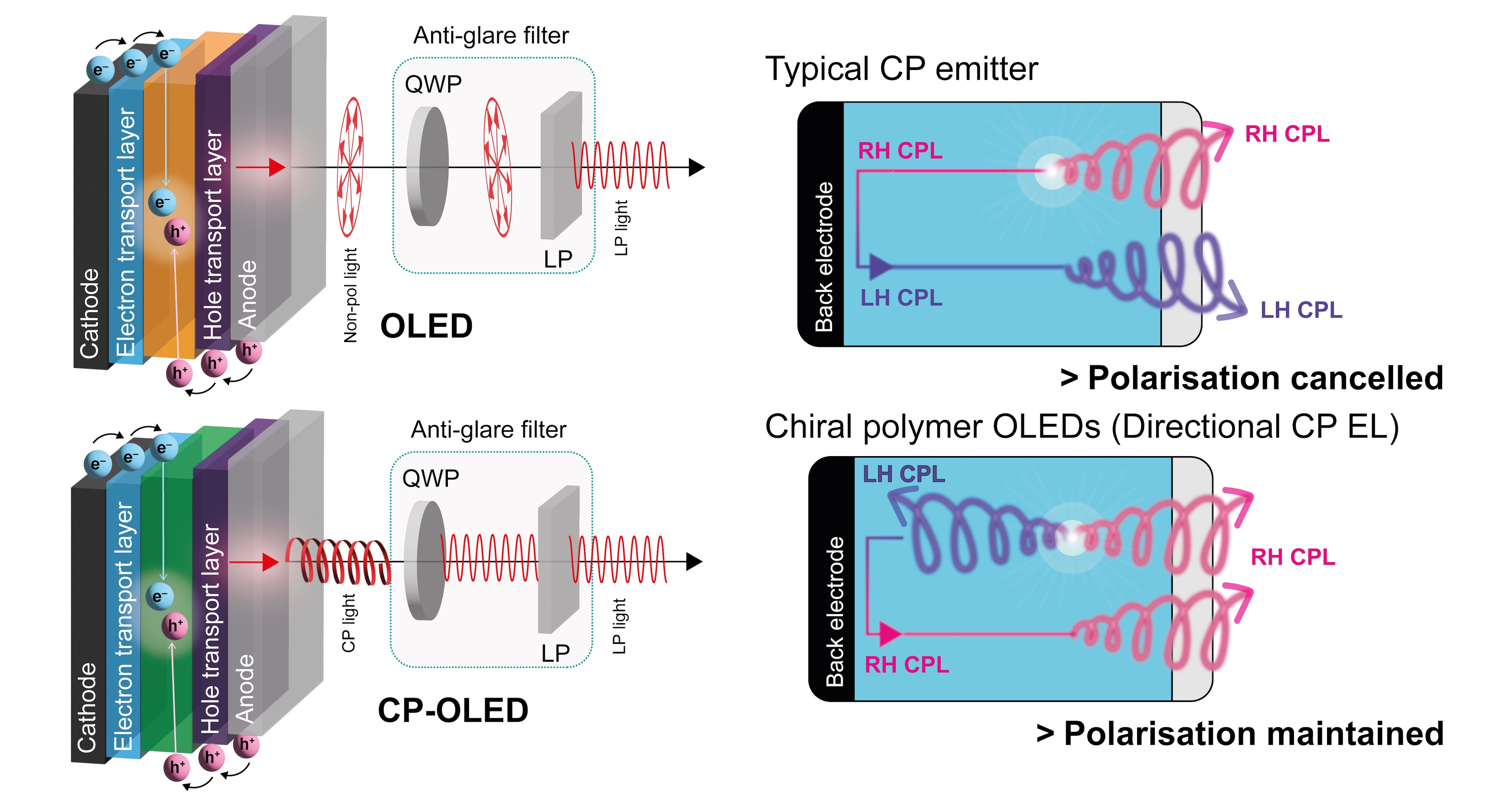
Our most successful approach is based on organic blend materials, which consist of a chiral small molecule and a non-chiral polymer mixture. For example, by combining a conventional light emitting polymer (F8BT) with a small amount of a single handed helically chiral aromatic (a helicene), we have shown that we are able to generate substantial levels of CP photo- and electroluminescence from the polymer. We have optimised this approach to achieve leading levels of circular polarisation from CP-OLEDs and uncovered novel fundamental mechanisms that underpin the chiroptical behaviour of such materials. For example, we have discovered ‘anomalous’ mechanisms for the generation of CP electroluminescence in devices, which are proposed to occur through the orbital polarisation of charge carriers as they propagate through the chiral active layer material. We have also proposed other mechanisms to enhance level of CP in conjugated materials, including through energy transfer. Representative recent publications: Nat Photon. 2025, 19, 1361. DOI; Adv. Mater. 2024, 2402194. DOI. Nat. Photon. 2023, 17, 193. DOI.
Chiral light detection
The development of CP light-based technologies to their full potential requires the realisation of miniature, integrated devices that can detect the ‘handedness’ of CP light. The circularly selective optical response of chiral functional materials makes them an exciting prospect for direct detection of CP light without the need for external optics.
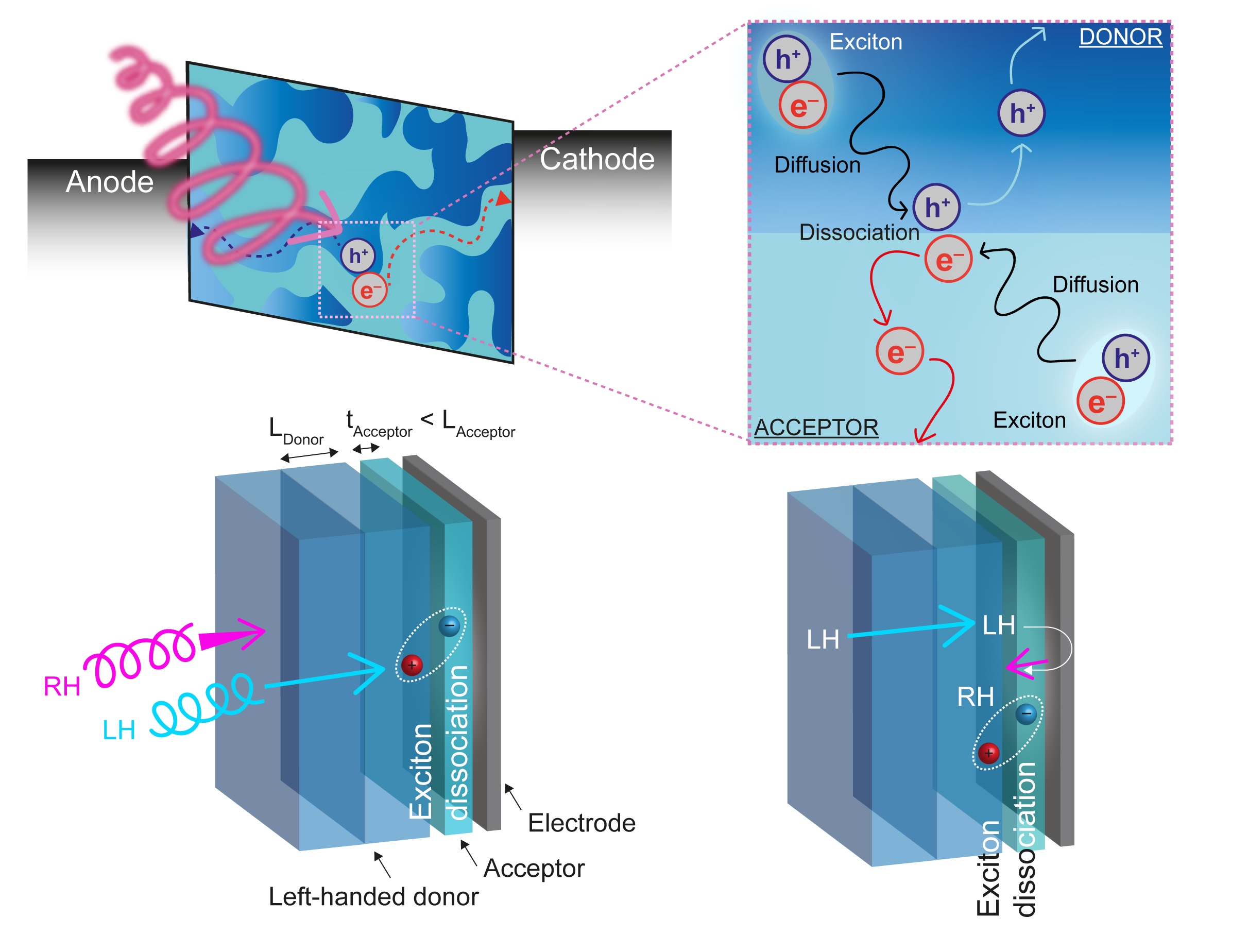
We have studied the prospect of using a range of chiral materials in a range of device configurations for the direct detection of CP light. These include photodiodes, phototransistors and photoconductors, spanning chiral small molecules, polymers, nano materials and hybrid organic-inorganic metal halide perovskites. Through such study we have learn much in the relationships between material CP dissymmetry and device CP dissymmetry. Representative recent publications: Adv. Mater. 2024, 2314337. DOI; ACS Nano, 2022, 16, 2682. DOI; Adv. Mater. 2021, 33, 2004115. DOI; Adv. Opt. Mater. 2021, 2101044. DOI.
Function via chiral composition
It is well-known that the key to successful and high-performance organic devices is the need to link well-understood characteristics of an isolated molecule (so-called “molecular” properties) into the collective behaviour of multiple units in thin films (“material” properties). When employing a chiral organic semiconducting material, it is possible to use a range of chiral compositions, differing in the proportion of left- and right-handed structures; the most common being a racemate (a 50:50 mixture of left-handed and right-handed molecules) and an enantiopure (single handedness) composition. As the right- and left-handed enantiomers of a given chiral material have identical “molecular” properties, such properties would not be expected to change when comparing an enantiopure composition to a racemate. However, enantiopure and racemic materials have different bulk packing and therefore different bulk material properties. This possibility to exploit chirality to alter the “material” properties without affecting the “molecular” properties is a fascinating concept which we continue to explore.
We have previously shown that the bulk performance of both chiral small molecules and chiral nanomaterials can be controlled using chiral composition.
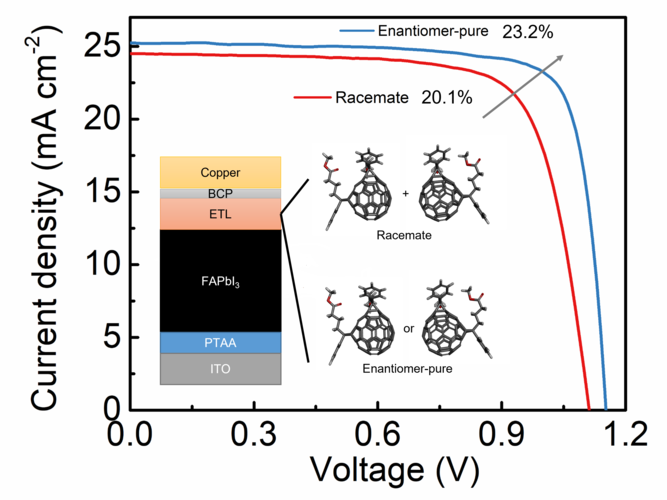
For example, chiral fullerene electron-transport layers within perovskite solar cells (PSCs) were found to give significantly improved performance as a single enantiomer material. Representative publications: J. Mater. Chem. A. 2025, 13, 6089. DOI; Adv. Energy Mater. 2023, 13, 2300054. DOI; ACS Nano 2017, 11, 8329. DOI.
Controlling anisotropy
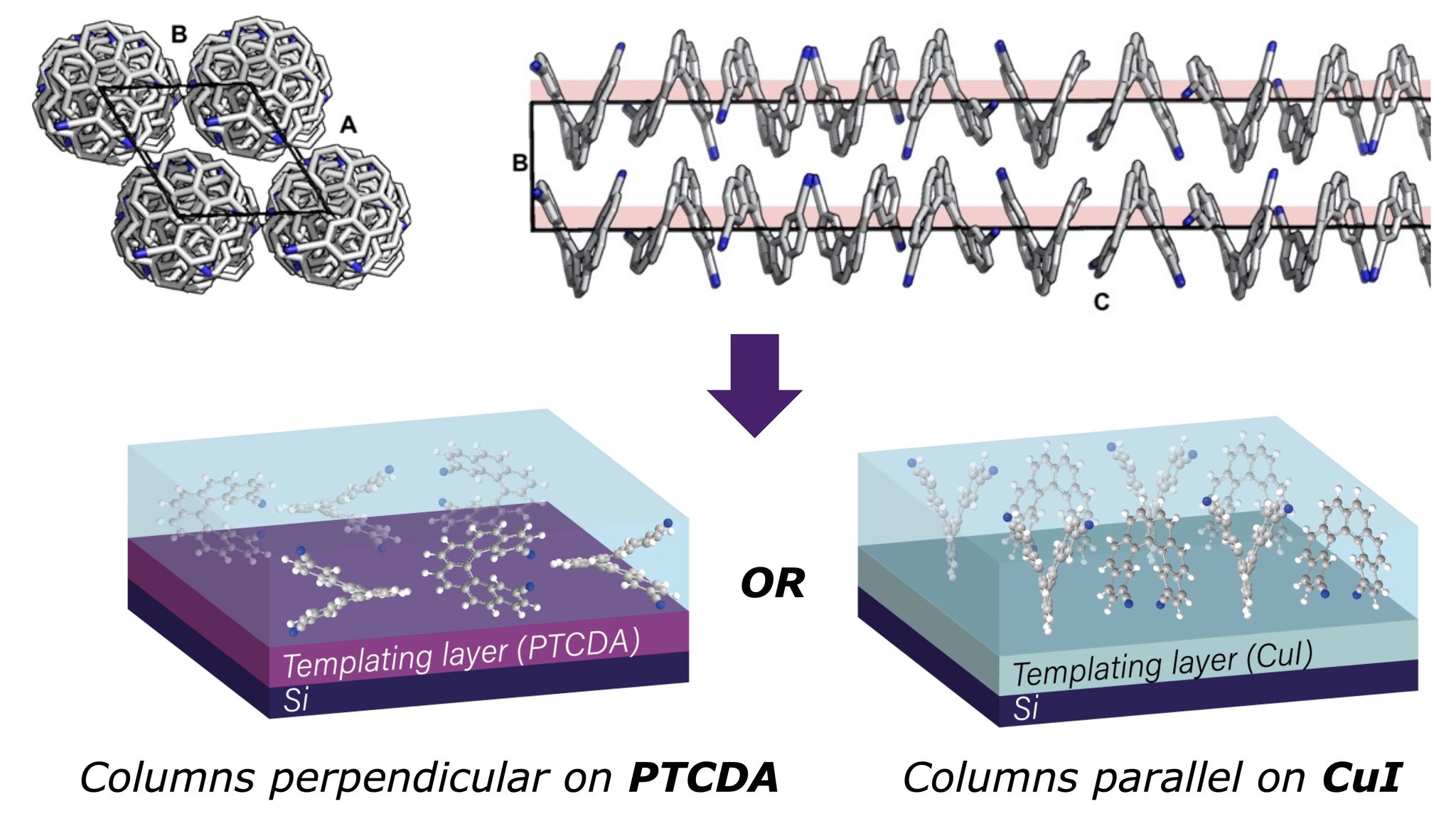
One challenge in the area of chiral materials is the intrinsically anisotropic (directional) nature of chiral-dependent properties, such as the absorption and emission of CP light or the transport of spin-polarised electrons. As a result, the orientation of chiral molecules relative to other interfaces, along with the directionality of the measurement, are critical to determine the functionality and efficiency of chiral materials and devices. We recently reported a strategy to control the orientation of a helicene by using organic and inorganic templating layers. Such templating layers can either force the helicene to adopt a face-on orientation and self-assemble into upright supramolecular columns oriented with their helical axis perpendicular to the substrate, or an edge-on orientation with parallel-lying supramolecular columns. Through such control, we show that low- and high-energy chiroptical responses can be independently ‘turned on’ or ‘turned off’. The templating methodologies described here provide a simple way to engineer orientational control and, by association, anisotropic functional properties of chiral molecular systems for a range of emerging technologies. Representative publication: Nat. Chem. 2022, 14, 1383. DOI.